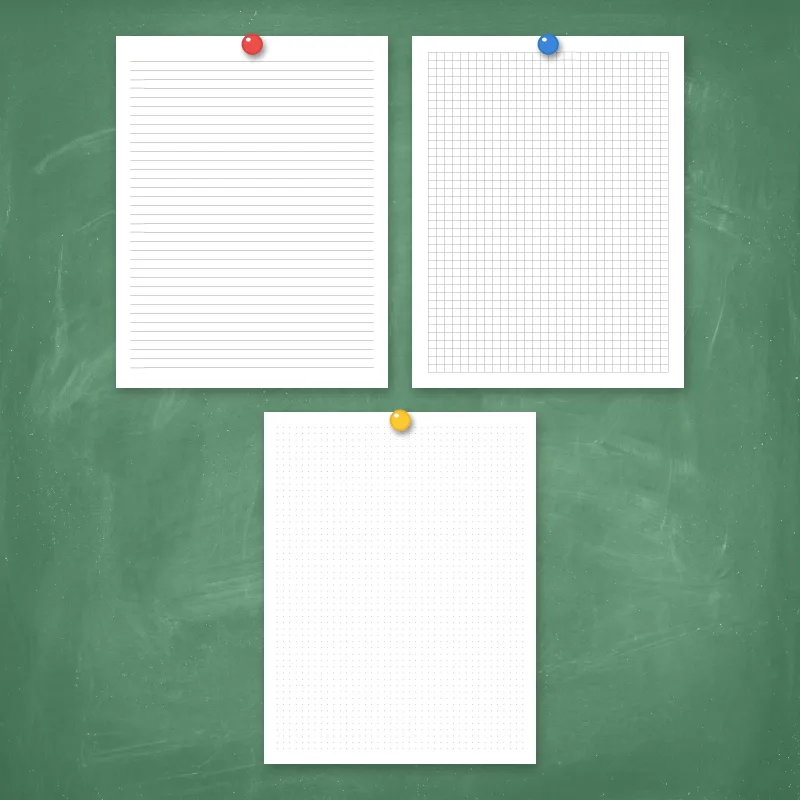
Printable paper comes in a lot of rulings, and the right one depends on who is writing and what for. Here's what each kind is for, so you print the right page the first time. Every page below is a free download.
Lined paper: wide, college or narrow ruled?
- Wide ruled (11/32 in, about 8.7 mm between lines): the roomiest lines. Good for early grades and anyone with big handwriting.
- College ruled (9/32 in, about 7.1 mm): the everyday notebook ruling for older students and adults, with more lines on each page.
- Narrow ruled (1/4 in, 6.35 mm): for small, neat handwriting and long notes.
- 8 mm and 6 mm: the standard and narrow rulings in UK exercise books.
Not sure? Start with college ruled, and switch to wide ruled for younger kids. Landscape pages are handy for long lists and notes side by side.
Graph paper: which square size?
- 1/4 inch (4 squares to the inch, about 30 by 40 squares on a US Letter page): standard school graph paper in the US and Canada, for maths, charts and floor plans.
- 5 mm: the metric grid used in maths books in the UK and Europe. A little smaller, so more squares on the page.
- 1 cm: bigger squares that are easier for kids' maths, area and counting.
- 1/2 inch (about 15 by 20 squares on a page): big squares for young kids, for pixel art, lining up sums and drawing arrays.
Which graph paper is best for pixel art?
Each square is one pixel, so the square size decides how detailed the picture can be. For young kids with markers or crayons, use 1/2 inch: a square is big enough to fill neatly. For older kids and adults with fine pens, use 1/4 inch or 5 mm and you'll fit far more detail. Sketch the outline lightly in pencil first, then colour square by square.
Handwriting paper for young kids
Primary handwriting paper has a solid top line, a dashed middle line and a baseline. Capitals and tall letters reach the top line, small letters the dashed middle. The line height shrinks as children grow:
- 1 1/8 inch: Pre-K
- 3/4 inch: Kindergarten
- 5/8 inch: Grade 1
- 1/2 inch: Grade 2
- 3/8 inch: Grade 3
Story paper adds a picture box at the top, so kids draw first and then write about it.
Dot grid paper
Dot grid gives you a guide for lines, boxes and lettering without the lines showing in what you make.
- 5 mm dots: the bullet journal standard, for journaling, planners, layouts and hand lettering.
- 1/4 inch dots: a little more room, matching US graph paper.
Cornell notes for class and lectures
Cornell notes split the page into three parts: a narrow cue column on the left, a wide notes column on the right and a summary box at the bottom. You take notes in class, add a question for each idea in the cue column afterwards, then sum up the page in a few sentences. Covering the notes and answering your own questions is a quick way to revise before a test.
The standard layout puts the cue column 2.5 inches from the left edge and the summary 2 inches from the bottom of a US Letter page. College ruled lines suit most students; graph or dot grid notes work better for maths and science.
Get the Cornell notes template
Which page size?
US Letter and A4 are full pages for school and home. A5 and Half Letter are half-size pages that fit most planner binders and disc notebooks. Every paper above comes in all four.
How to print so the sizes stay exact
- In the print window, choose 100% or Actual size, not Fit to page. Fit to page shrinks the page slightly, so a 1/4 inch square comes out a little smaller.
- Plain printer paper works well. For fountain pens or markers, a heavier paper stops ink showing through.
More tips in our printing guide.
Enjoying Our Creative Journal & Blog?
Become a member today to unlock our full digital stationery vault, seasonal pattern collections, and exclusive perks.